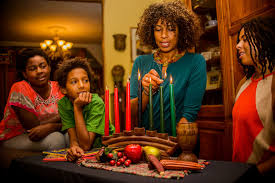
Let the Dunbar Heritage Association help you find ways to implement the Kwanzaa celebration into your holiday traditions. See the information and resources below.
Kwanzaa is a non-religious, cultural holiday that focuses on family, community, and culture created by Dr. Maulana Karenga. The celebration is modeled after the first harvest celebrations in Africa, and the meaning of the name Kwanzaa comes from the Swahili phrase “matunda ya kwanza” which means the “first fruits” of the harvest. The annual celebration takes place from December 26 thru January 1.
Step 1: Set up the Table
How to set up the Kwanzaa table
Seven symbols of Kwanzaa
- 1st: Decorate the table with an African print cloth or using the colors red, black, or green.
- 2nd: Place the mkeka (a woven mat) in the center of the table which represents the foundation and Kwanzaa principles.
- 3rd: Place the kinara (candleholder) and insert the mishumaa saba (seven candles) into the kinara. The black candle goes in the middle, the red green candles go to the left, and the three green candles go to the right.
- The seven candles represent the Nguzo Saba, the seven principles of Kwanzaa.
- 4th: Add mazao (crops) by arranging various fruits, vegetables, and nuts to represent the harvest around the kinara.
- 5th: Place the muhindi (ears of corn) to represent the number of children you have or one or two if you don’t have any children.
- 6th: Set the Kikombe cha Umoja (Unity cup) on the table, which represents unity and will be used to pour libations to honor the ancestors and to share a communal drink.
- 7th: Arrange the zawadi, handmade gifts, on the table.
Step 2: The celebration starts with a greeting!
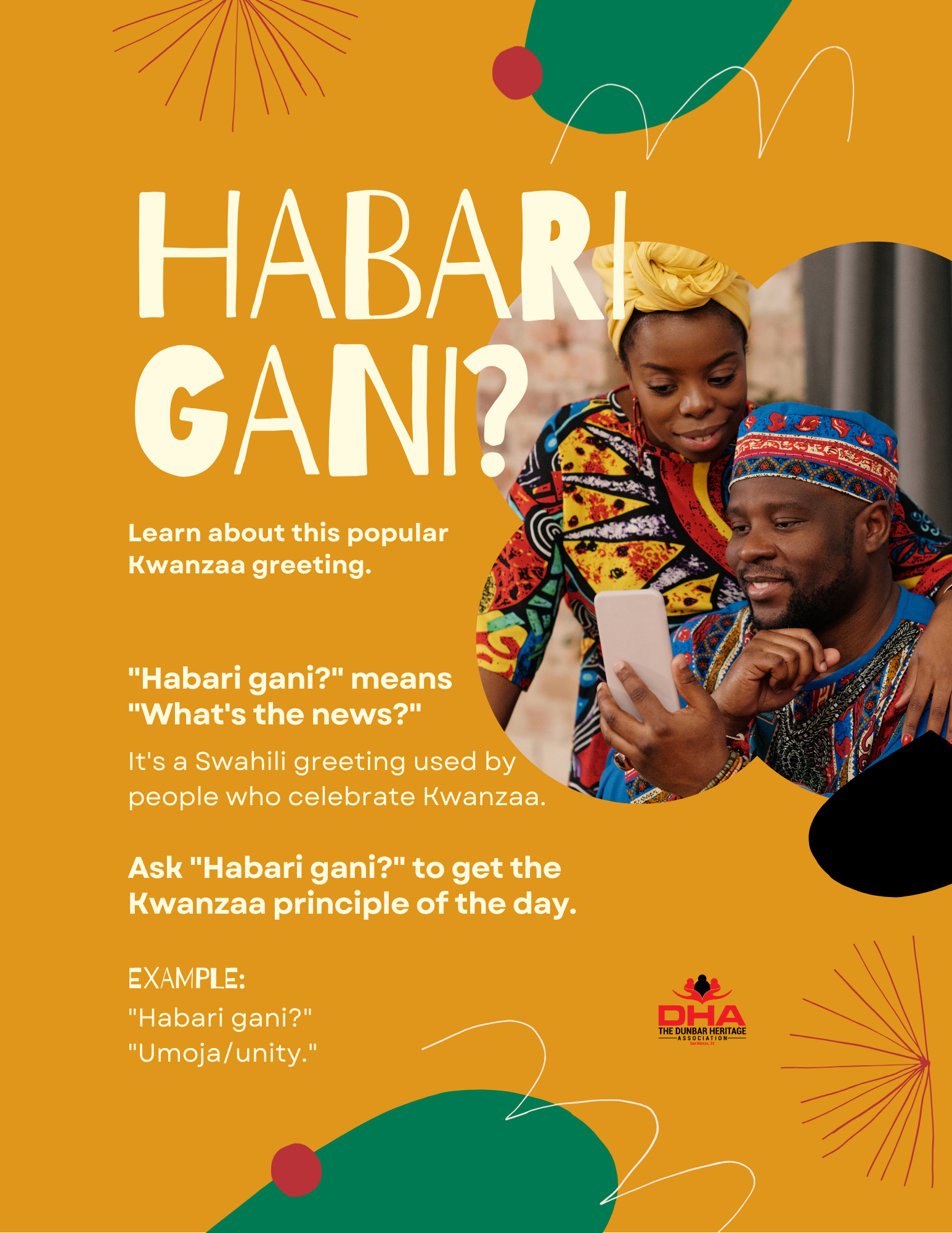
On each night of Kwanzaa, celebrants ask “Habari gani” meaning what’s the news, followed by the response which is the principle of the day.
Step 3: Lighting the Kinara nights 1-7
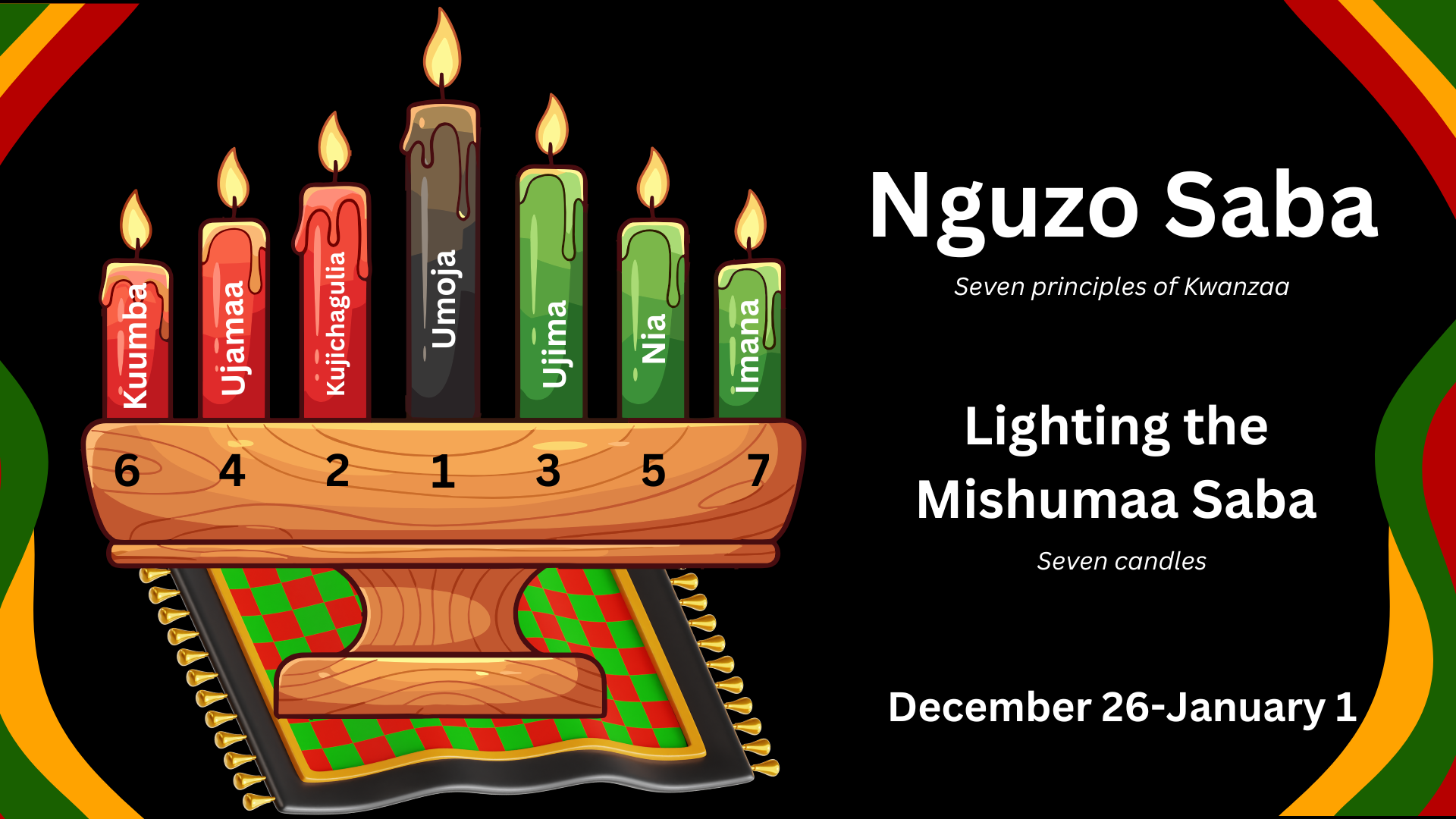
Lighting the Mushumaa Saba in order.
The candles are lit according to the order of the Kwanzaa principles beginning with the black candle Umoja (1); Then the candles are lit alternately from left and right starting with the innermost red candle next to the black for Kujichagulia (2); then green candle for Ujima (3); redt, Ujamaa (4); green, Nia (5); red, Kuumba (6); and Imani (7).
Each night of the celebration highlights one of the 7 principles of Kwanzaa, known as the Nguza Saba.
- Umoja (Unity): To strive for and to maintain unity in the family, community, nation, and race.
- Kujichagulia (Self-Determination): To define ourselves, name ourselves, create for ourselves, and speak for ourselves.
- Ujima (Collective Work and Responsibility): To build and maintain our community together and make our brothers’ and sisters’ problems our problems and to solve them together.
- Ujamaa (Cooperative Economics): To build and maintain our own stores, shops, and other businesses and to profit from them together.
- Nia (Purpose): To make our collective vocation the building and developing of our community in order to restore our people to their traditional greatness.
- Kuumba (Creativity): To do always as much as we can, in the way we can, in order to leave our community more beautiful and beneficial than we inherited it.
- Imani (Faith): To believe with all our hearts in our people, our parents, our teachers, our leaders, and the righteousness and victory of our struggle.
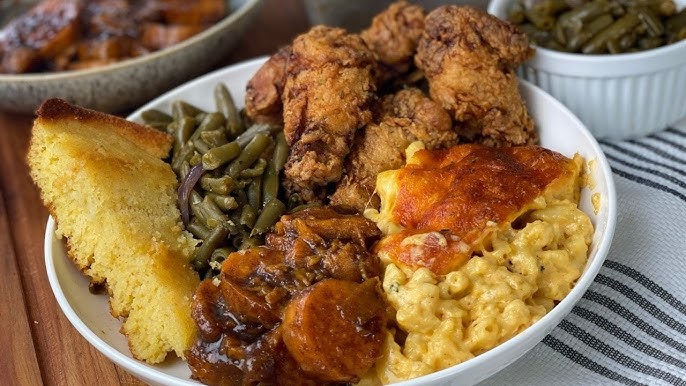
On the sixth night (Dec. 31st), celebrants gather for Karamu, the Kwanzaa feast.
Happy Kwanzaa from DHA!
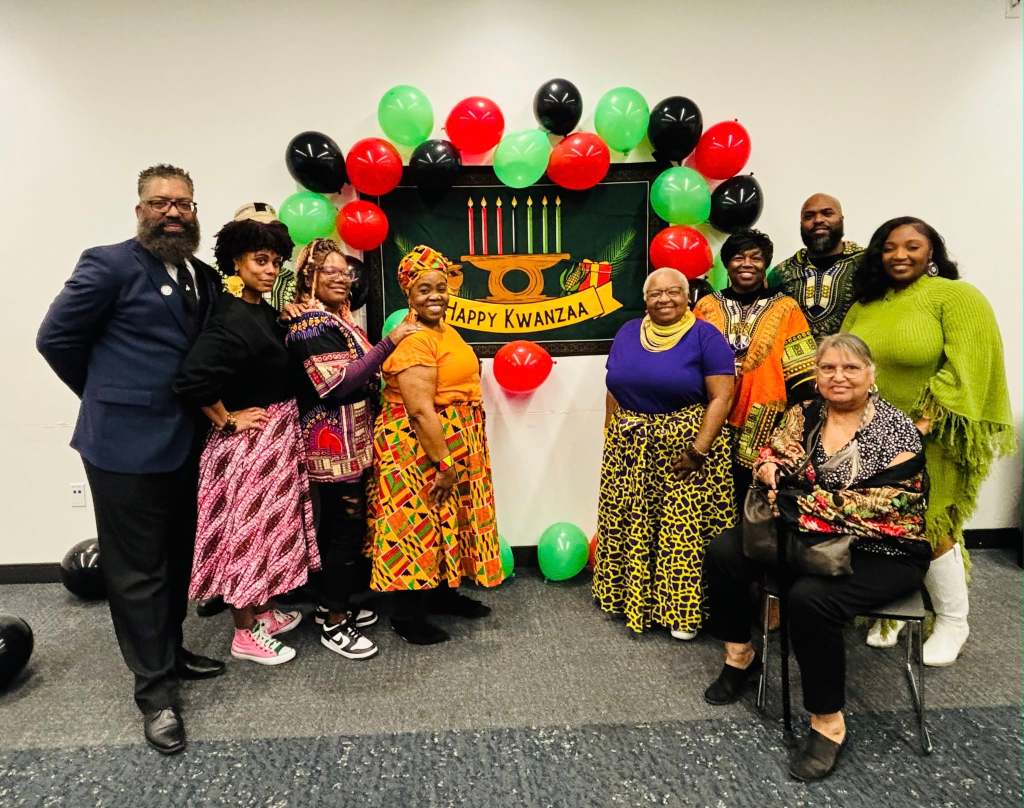
For more information on the history, symbols, and ways to celebrate Kwanzaa, see the resources below.
The official Kwanzaa website by founder, Maulana Karenga
Kwanzaa-First Fruits, The National Museum of African American History & Culture

Take a picture with the DHA Kinara and post to social media #dhasmtx
See the DHA life-sized Kinara on the courthouse square in December!
Discover more from Dunbar Heritage Association
Subscribe to get the latest posts sent to your email.
 Dunbar Heritage Association